

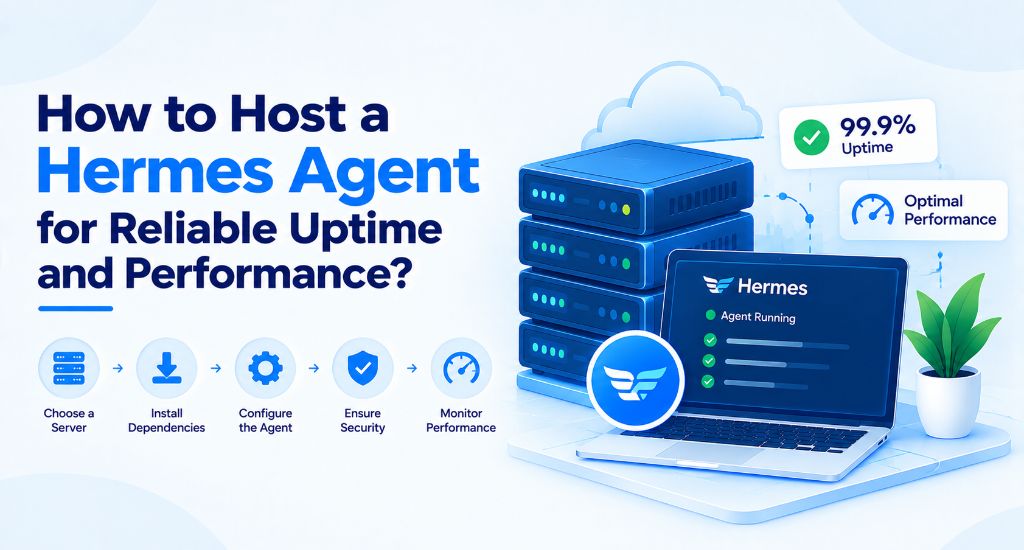
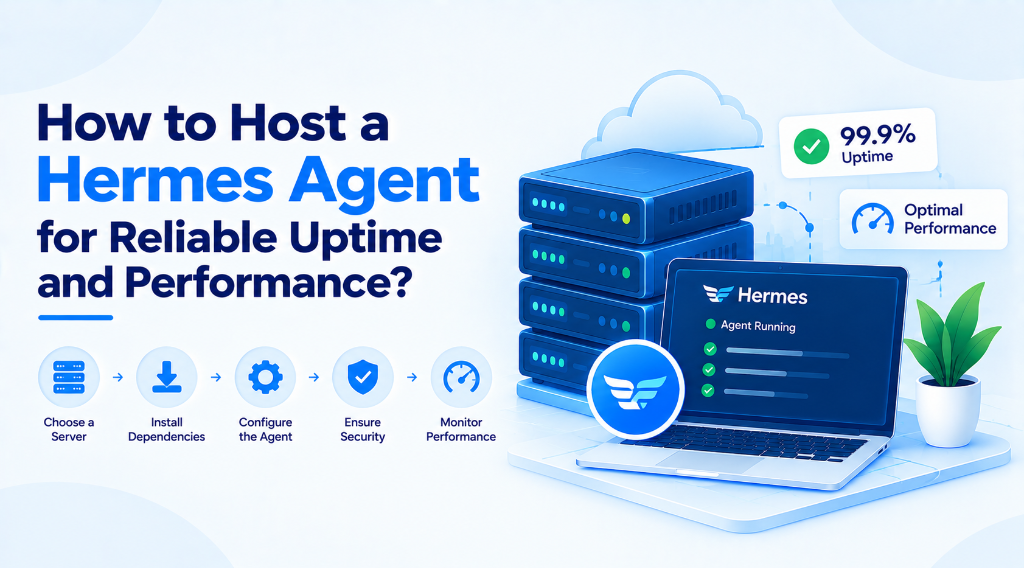
A Hermes agent runs best on infrastructure built for constant activity, and Hermes agent hosting for uptime starts with the right server foundation. These agents process requests around the clock, handle background tasks, and respond to triggers without a fixed schedule. A server that drops connections or restarts mid-task breaks that rhythm and creates gaps a user notices immediately.
The server layer decides how the agent performs under load, and choosing low-cost VPS for AI agents deserves early attention rather than an afterthought. A VPS built for this purpose supports steady CPU access, predictable memory, and fast storage. Picking one that matches the agent’s actual workload keeps costs reasonable without sacrificing the performance the agent needs daily.
What Is a Hermes Agent?
A Hermes agent runs in the background nonstop. It handles tasks and catches triggers and moves on. It operates without ongoing human input. It handles scheduled jobs, monitors data streams, and completes actions the moment conditions call for them. The agent depends on constant server availability, since a pause in execution creates a gap in whatever workflow it supports.
Unlike a standard web application, the agent rarely sits inactive. It checks conditions, processes inputs, and writes outputs on a near-continuous cycle. That pattern places different demands on a server than a typical website, and hosting decisions need to reflect that difference from the start.
Why Uptime Matters
An agent that goes offline mid-task leaves that task incomplete, and recovery depends on how the server handles the restart. Visitors often overlook a brief website outage. A short outage for a Hermes agent can mean a missed trigger, a stalled job, or a broken sequence of dependent actions.
MilesWeb’s VPS infrastructure runs on a 99.95% uptime commitment, which matters more for an agent than for most websites, since every dropped connection interrupts a task mid-execution rather than a page load. Building around dependable infrastructure protects the agent’s output, not just its availability.
Server Requirements
A Hermes agent needs resources allocated to it directly, not shared unpredictably with other tenants on the same physical machine. Three factors decide whether the setup holds up under real conditions: processing capacity, storage speed, and isolation from other workloads.
CPU and Memory
Limited processing power leads to the rapid formation of task queues, undermining the purpose of an agent designed for immediate response. A minimum of two dedicated vCPU cores handles most single-agent workloads comfortably, while multi-agent setups benefit from four or more. Memory planning should account for the busiest hour of the week, not the average across seven days, because agents typically perform reliably during low-traffic hours.
Storage and Network
An agent that writes logs constantly needs storage that keeps pace. NVMe drives outperform standard SSDs on write-heavy workloads by a wide margin, which matters when an agent records every action for auditing or debugging later. Network stability matters just as much: an agent calling external APIs multiple times a minute needs a connection with minimal packet loss, since a dropped request can stall an entire task chain until it times out and retries.
Isolation and Security
Resource isolation protects an agent from a noisy neighbor on the same server. A KVM-based VPS assigns dedicated resource pools per account, which prevents one tenant’s traffic spike from slowing another’s agent. An agent handling sensitive data, such as customer records or financial triggers, benefits from an isolated database instance rather than a shared one, which limits exposure if another account on the server runs into trouble.
Picking the Right VPS
A suitable VPS plan for a Hermes agent is determined by a concise set of criteria, each linked to a specific failure mode the agent may encounter:
- Dedicated CPU and RAM: Assigned to the account rather than pooled across tenants during traffic spikes.
- SSD or NVMe Storage: High IOPS capability, since continuous logging and frequent task writes overwhelm slower drives quickly.
- Scalable Plan Structure: Allowing resources to grow smoothly as the agent takes on more concurrent tasks.
- Low Latency Server Location: Positioned near the agent’s primary data sources, which trims response delay on every external call.
- Built-in Monitoring and Alerts: Real-time telemetries so resource strain surfaces before it affects task completion.
A few direct questions to a provider before signing up reveal more than a features page ever does. What happens during a hardware failure on the host machine? Is failover automatic or manual? How quickly does support respond when an agent goes unresponsive at an inconvenient hour? A provider willing to answer these in detail usually delivers the reliability an agent depends on.
Concluding Insights
A Hermes agent performs at its best on a server built for continuous work, not intermittent traffic. Matching the CPU, memory, and storage to the agent’s actual task load prevents slowdowns and missed triggers caused by undersized infrastructure, while isolating the agent from other tenants eliminates one of the common causes of unexpected slowdowns. MilesWeb’s VPS plans pair dedicated resources with NVMe storage, which gives a Hermes agent the consistent throughput it needs without added configuration work.
Hosting a Hermes agent well means matching resources to real demand and reviewing performance as that demand grows. A server built for continuous work keeps the agent doing exactly what it was designed to do, day after day, running on infrastructure that grows with it.
Recommended Resources & Related Links:
- AOWSM: Explore advanced enterprise web applications, software engineering, and digital workflows at AOWSM.
- RankReady Pro: Practice with real exam patterns, predict your rank with AI, and discover your dream college — all in one platform. RankReady Pro.
- Website & Digital Solutions: For bespoke web development and end-to-end digital architecture, visit Absolute Online Web.